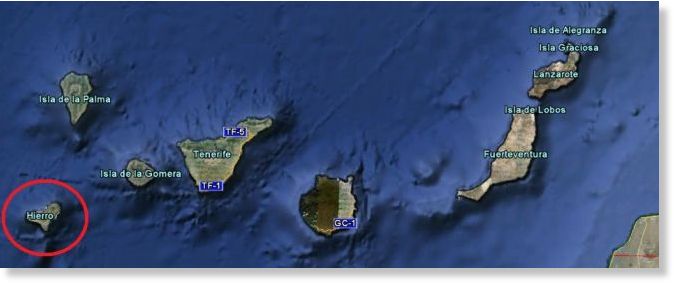
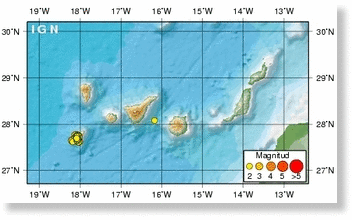
The Canary Islands Government has raised the alert level for the El Hierro volcano in the Canary Islands to 'Yellow'.
Spanish seismologists, held a press conference on Sunday to communicate to the 10,000 residents of the smallest of the Canary Islands that the raising of the alert level does not indicate that an eruption is imminent. They indicated, however, that the number of volcanic earthquakes detected beneath El Hierro continues to increase.
Hierro, a shield volcano, has had a single historic eruption from the Volcan de Lomo Negro in 1793. The eruption lasted approximately one month and produced lava flows.
The Canary Islands Government commenced an in-depth geological survey of El Hierro earlier this month in an effort to determine the source of an earthquake swarm.
The unprecedented seismic activity commenced on 19 July. In excess of 7,000 earthquakes have been recorded up to Monday, 26 September 2011. More than 50 earthquakes were recorded between midnight and 6:00 a.m. GMT on Monday. The earth tremors have ranged between 1 and 3 magnitude.
The vast majority of the tremors have been recorded in the northwest island at El Golfo, the location of a massive landslide that created a 100-metre high tsunami almost 50,000 years ago.
Speaking to the
El Pais newspaper during the weekend, volcanologist Juan Carlos Carracedo suggested that an eruption on El Hierro would "not be a major surprise".
He explained: "It is the youngest of the Canary Islands. There is a ball of magma which is rising to the surface and it is stationed at the limit of the earth's crust. At the moment we do not know if that ball of magna will break the crust and cause an eruption."
Earthquake swarms are events where a local area experiences sequences of many earthquakes striking in a relatively short period of time. The length of time used to define the swarm itself varies, but an event may last for days, weeks, or months.
El Hierro is situated in the most southwestern extreme of the Canaries. The island was formed after three successive eruptions, and consequent accumulations, the island emerged from the ocean as an imposing triangular pyramid crowned by a volcano more than 2,000 metres high.
Although over 200 years have elapsed since the last eruption, El Hierro has the largest number of volcanoes in the Canaries with over 500 open sky cones, another 300 covered by the most recent outflows, and some 70 caves and volcanic galleries.
Paula.